Project Overview
Dataset Analysis
The bird species dataset contains diverse images across 25 different bird species with the following characteristics:
1,352
Total Images
1,227
Training Images
125
Testing Images
Each image was standardized to 224×224 pixels with 3 color channels. The data preparation process involved transforming raw bird images into a format suitable for deep learning, followed by data normalization to improve model performance.
# Data transformation pipeline
transform = transforms.Compose([
    transforms.Resize((224, 224)),
    transforms.ToTensor(),
    transforms.Normalize((.229, .224, .225), (.485, .456, .406)) # ImageNet normalization
])
Model Architecture Comparison
I implemented and compared three popular CNN architectures, each with different depths and architectural characteristics:
AlexNet
The winner of the 2012 ImageNet challenge with 8 layers. Used as our baseline model for comparison.
- 8 layers total (5 convolutional, 3 fully connected)
- Total training time: 437.42 seconds
- Best optimizer: RMSprop
- Best epoch: 14
- Best performance (loss): 0.000859
VGGNet
Winner of the 2014 ImageNet challenge with 16 layers and small 3×3 filters throughout.
- 16 layers (13 convolutional, 3 fully connected)
- Total training time: 379.21 seconds
- Best optimizer: Adam
- Best epoch: 13
- Best performance (loss): 0.000247
ResNet
The 2015 ImageNet challenge winner with 152 layers and special skip connections.
- 152 layers with residual connections
- Total training time: 502.46 seconds
- Best optimizer: RMSprop
- Best epoch: 11
- Best performance (loss): 0.001461
Optimization Methods
A key aspect of this project was evaluating different optimization algorithms to find the most effective approach for each model. I tested three optimizers:
Adam
Adaptive Moment Estimation combines benefits of AdaGrad and RMSProp.
- Best for: VGGNet
- Achieved lowest overall loss (0.000247)
- Quick convergence in early epochs
- Consistent performance after initial convergence
SGD
Stochastic Gradient Descent with momentum.
- Most stable training curves
- Slower convergence than other optimizers
- ResNet with SGD showed minimal standard deviation
- Steady improvement throughout all epochs
RMSprop
Root Mean Square Propagation adapts learning rates based on recent gradients.
- Best for: AlexNet and ResNet
- Fastest convergence for ResNet
- ResNet achieved 100% test accuracy
- Some fluctuations in later epochs
# Optimizer configuration example for ResNet with RMSprop
learning_rate = 1e-4
optimizer = torch.optim.RMSprop(cnn_model.parameters(), lr=learning_rate)
loss_fn = nn.CrossEntropyLoss()
Performance Visualizations
Accuracy Comparison
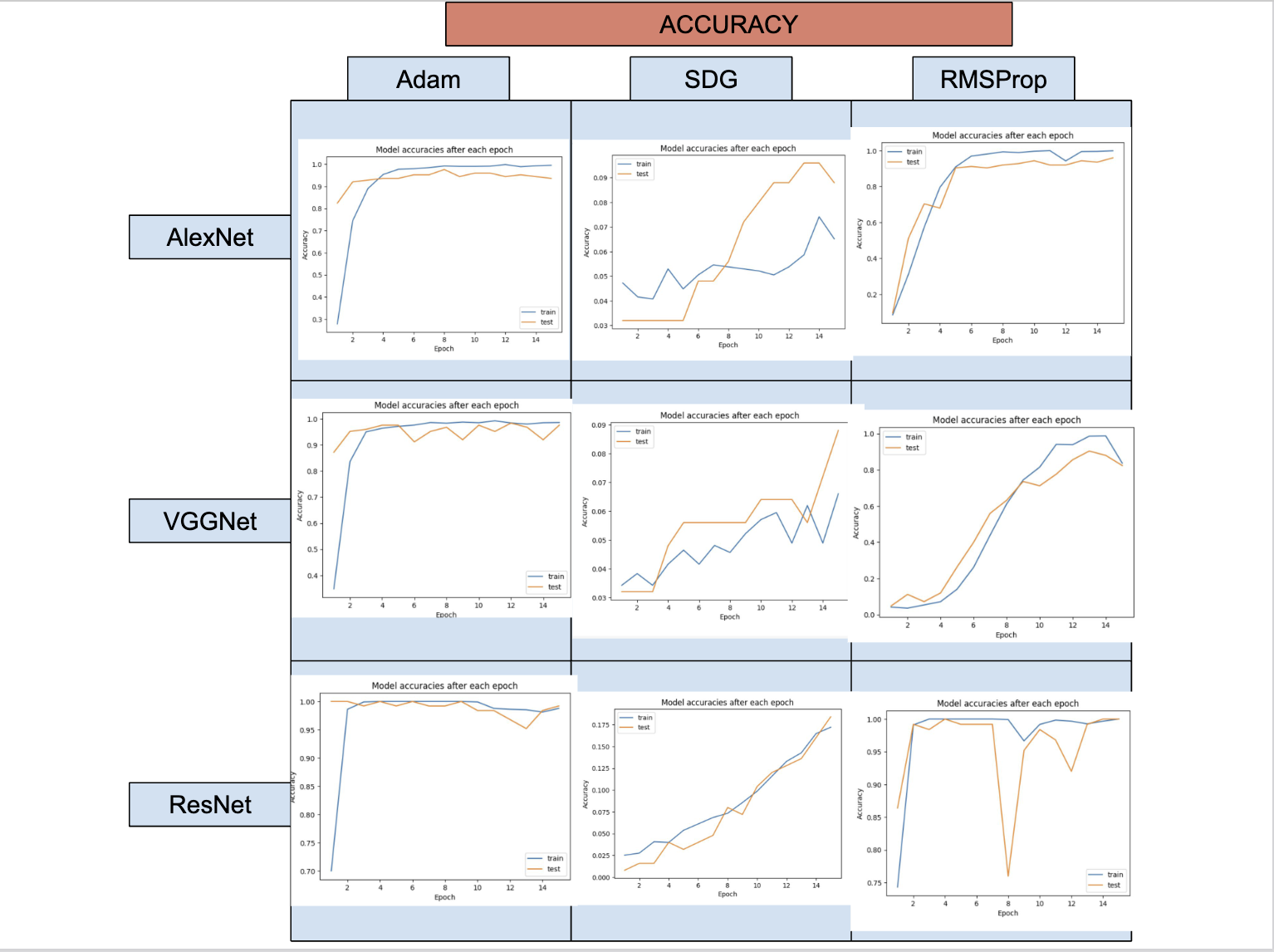
Accuracy curves for AlexNet, VGGNet and ResNet across different optimizers showing training and test accuracy over epochs.
Loss Curves
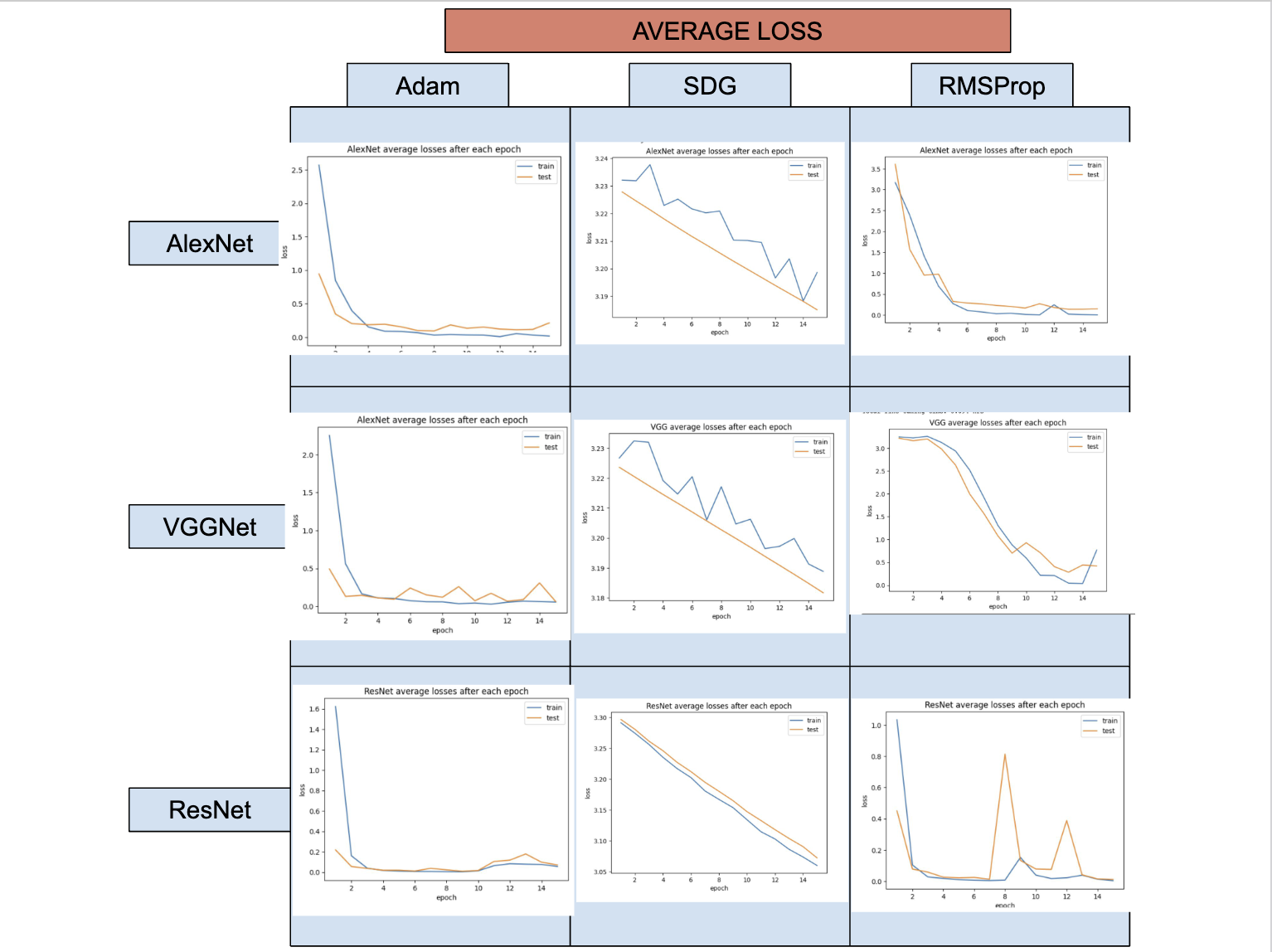
Training and testing loss curves showing convergence patterns for each model-optimizer combination.
Confusion Matrices
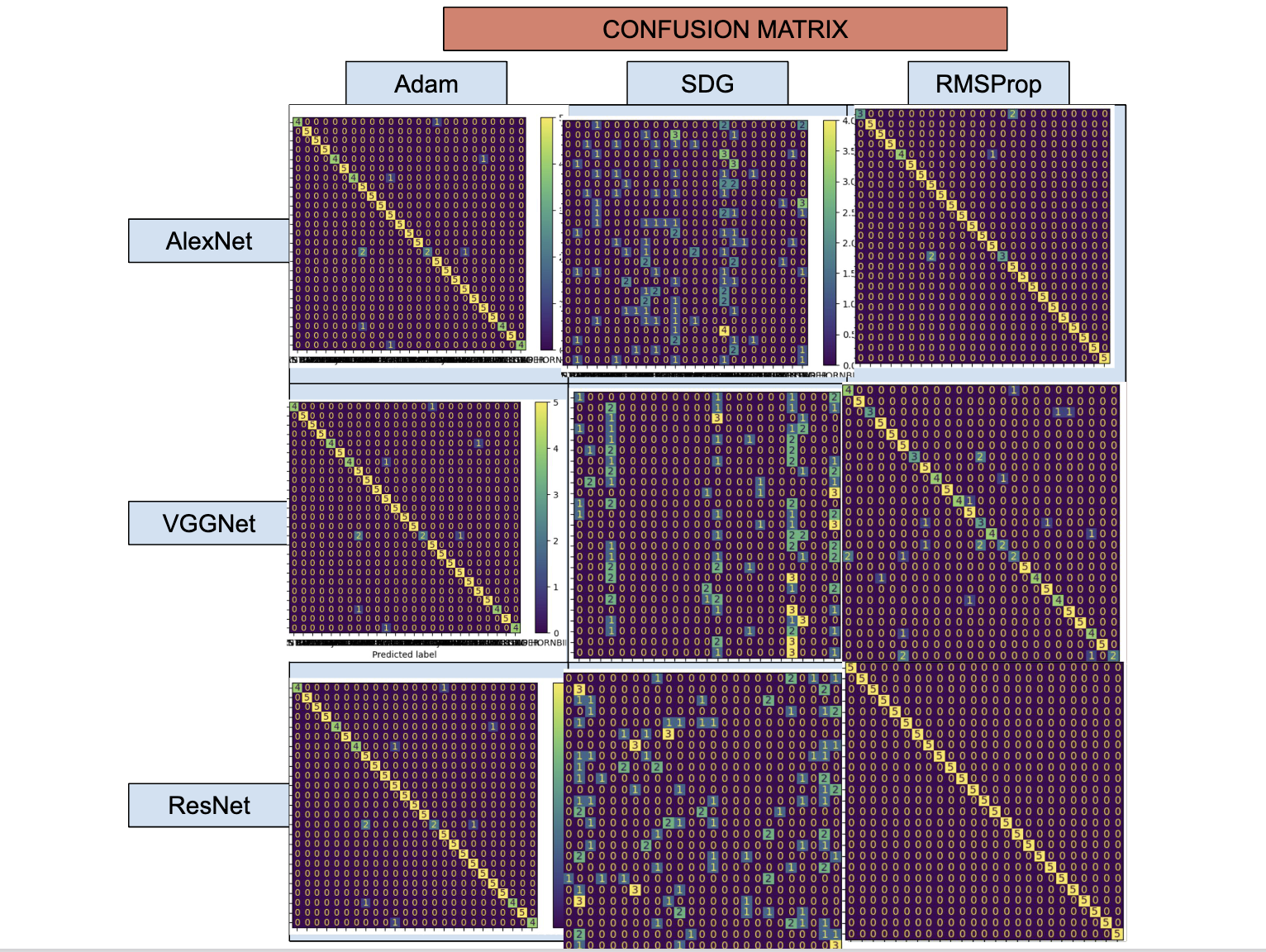
Confusion matrices visualizing classification performance across all 25 bird species.
Implementation Details
All models were implemented using PyTorch and fine-tuned from pre-trained weights on ImageNet. Each model underwent architectural modifications to classify our 25 bird species:
ResNet Implementation Example
class ResNet152(nn.Module):
    def __init__(self, num_classes, pretrained=True):
        super(ResNet152, self).__init__()
        net = models.resnet152(pretrained=True)

        # Modify final layer for our classification task
        num_features = net.fc.in_features
        net.fc = nn.Linear(num_features, num_classes)

        # Transfer components from pre-trained model
        self.conv1 = net.conv1
        self.bn1 = net.bn1
        self.relu = net.relu
        self.maxpool = net.maxpool
        self.layer1 = net.layer1
        self.layer2 = net.layer2
        self.layer3 = net.layer3
        self.layer4 = net.layer4
        self.avgpool = net.avgpool
        self.fc = net.fc

    def forward(self, x):
        x = self.conv1(x)
        x = self.bn1(x)
        x = self.relu(x)
        x = self.maxpool(x)
        x = self.layer1(x)
        x = self.layer2(x)
        x = self.layer3(x)
        x = self.layer4(x)
        x = self.avgpool(x)
        x = torch.flatten(x, 1)
        x = self.fc(x)
        return x
Challenges and Solutions
Implementation Challenges
- Test Loop Evaluation: Fixed the test_loop() function to correctly track predictions and calculate confusion matrices.
- Optimization Testing: Created separate notebooks for each optimizer type to isolate and compare performance.
- Memory Management: Adjusted batch sizes and implemented efficient data loading to handle high-resolution images.
- Hyperparameter Tuning: Systematic testing to find optimal learning rates for each model-optimizer combination.
Learning Process
Throughout this project, I gained valuable insights into:
- Transfer learning techniques for computer vision tasks
- Implementing and fine-tuning state-of-the-art CNN architectures
- Impact of different optimizers on model convergence and performance
- Effective evaluation metrics for multi-class image classification
- Managing computational resources for deep learning projects
Key Findings and Conclusions
Performance Summary
After comprehensive testing across all model-optimizer combinations, these were the key findings:
- VGGNet with Adam achieved the lowest overall loss (0.000247)
- ResNet with RMSprop achieved 100% test accuracy on certain runs
- All models showed rapid improvement in the first 3-4 epochs
- VGGNet was the fastest to train (379.21s)
- ResNet took the longest (502.46s) but delivered exceptional accuracy
- Minimal misclassifications across models, with particularly strong performance from ResNet
Final Verdict
Based on my research, I found that ResNet with RMSprop is the most effective combination for bird species classification, achieving:
- Training Accuracy: 99.10%
- Test Accuracy: 98.40% (reaching 100% in optimization testing)
- Excellent generalization to new examples
- Strong performance across all 25 bird species
- ResNet's architecture, despite being the most complex, proved most effective at distinguishing subtle differences between similar bird species